
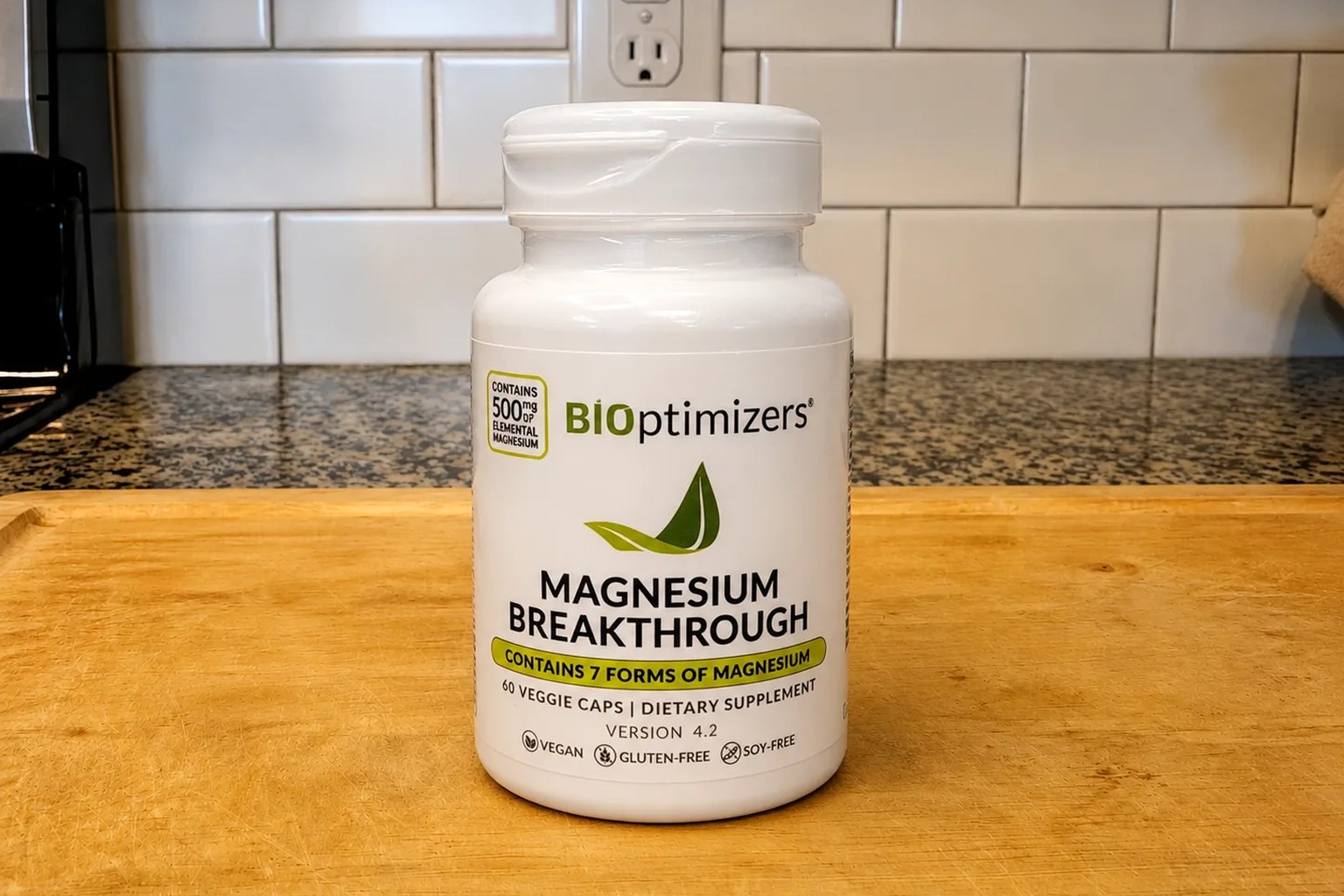
If you listen to podcasts, you have heard of Magnesium Breakthrough. BiOptimizers advertises it harder than just about anyone advertises magnesium — the pitch, repeated everywhere, is “7 forms of magnesium” in one capsule, on the theory that more forms means better absorption and broader benefit.
Give it this much: the formula isn’t the usual drugstore filler. There’s no cheap magnesium oxide padding out the count, the seven forms named on the label are all real, absorbable forms, and it adds a little vitamin B6. But this review turns on one checkable thing the marketing walks right past: how much of each form you’re actually getting. Here’s the full scorecard.
At a glance
Quick verdict
Magnesium Breakthrough is a real product with real magnesium, and it deserves credit where it’s due: no cheap oxide, seven genuine forms, a little B6, and a named sport certification on at least one variant. If all you want is “a magnesium that isn’t junk,” it clears that bar. That’s why it lands in Mixed rather than lower.
What holds it at 61 is disclosure and value, and both are specific. The seven forms are pooled into a single 1,701 mg proprietary blend, so the total 500 mg of elemental magnesium is the only number you get — the amount of each individual form is hidden, which is exactly the trick that lets a brand advertise premium forms while spending on cheap ones. A pharmacist quoted by Forbes made that point directly. The 500 mg dose also runs past the 350 mg supplemental limit, so loose stools are more likely, and at roughly $1.33 a serving you’re paying about three times what a plain, fully disclosed glycinate costs. It’s a fine formula sold with more marketing and less transparency than the fundamentals justify.
A consistent summary of formula, transparency, value and experience. Not a medical rating.
Scores follow our published 100-point methodology, applied identically to every product. View the scoring methodology.
May suit you if
- You specifically want a multi-form magnesium with no cheap oxide, and you’re comfortable not knowing the split between forms
- You’ve tried a single-form magnesium and want to experiment with a broader blend, and the marketing pitch appeals to you
- You want a magnesium with a named sport certification on the specific retail variant that carries it, and price isn’t your main concern
Skip it if
- You want to know exactly how much of each form you’re getting — the 1,701 mg proprietary blend won’t tell you, and that’s the whole point of the label
- You’re sensitive to magnesium’s laxative effect — 500 mg elemental in one serving exceeds the 350 mg supplemental limit and raises the odds of loose stools
- Value matters: a plain, disclosed glycinate does the fundamentals better for about a third of the price
Plain Google search link — not an affiliate link. The Ingredient Report earns nothing if you purchase this product.
Key findings
Product specifications
| Format | Capsules, 2 per serving, 60 capsules (30 servings) per bottle |
|---|---|
| Price (checked July 21, 2026) | ~$40 one-time; ~$35 on subscription |
| Cost per serving | ~$1.33 (2 capsules) |
| Elemental magnesium | 500 mg per serving — exceeds the 350 mg supplemental upper limit |
| Forms | Seven: chelate, bisglycinate, sucrosomial, malate, orotate, taurate, citrate |
| Amounts disclosed | Total elemental magnesium (500 mg) only; per-form amounts hidden in a 1,701 mg proprietary blend |
| Other actives | Added vitamin B6 |
| Independent testing | Informed Sport on one specific retail variant (not confirmed across all bottles) |
The formula: seven forms, one blind blend
Start with the credit, because it’s real. Magnesium Breakthrough avoids magnesium oxide — the cheap, poorly absorbed form that makes up the bulk of most drugstore magnesium — and instead names seven genuine forms: chelate, bisglycinate, sucrosomial, malate, orotate, taurate and citrate. It adds a little vitamin B6. And it does disclose the number that matters most in magnesium: 500 mg of elemental magnesium per two-capsule serving, not a compound weight dressed up to look bigger. On those points it’s ahead of the average bottle.
Then comes the deduction that defines the product. All seven forms are pooled into a single 1,701 mg proprietary blend. That means the only quantity you can see is the 500 mg elemental total — the amount of each individual form is not printed. So you cannot tell whether the bulk of your 500 mg is well-absorbed bisglycinate and taurate, or cheap citrate and malate doing the heavy lifting while the premium forms appear in token amounts. This is the exact mechanism a proprietary blend exists to hide, and a pharmacist quoted by Forbes made precisely this criticism of the product. There’s a second, quieter issue: 500 mg of elemental magnesium in one serving exceeds the 350 mg supplemental upper limit, which raises the odds of loose stools — more magnesium isn’t automatically better. Seven forms is a marketing number; the amounts are what would make it a formula, and those are the numbers you don’t get. Formula 15/25.
The testing column
The testing picture is genuinely mixed rather than empty. A named third-party certification — Informed Sport — appears on at least one specific retail variant of the product, which is a real, verifiable signal and more than many direct-to-consumer magnesiums offer. The honest limit is that we could not confirm the certification applies to every bottle sold under the Magnesium Breakthrough name across every channel and variant. So the fair statement is: a real certification exists on a specific version, not a blanket guarantee across the whole line. Testing 13/20 — credit for a named program, held back because we can’t confirm it’s universal.
What it’s like to take
We photographed the label but have not yet run our own long-term trial, so we’re not going to invent an experience we didn’t have. From customer reports, most people take the two capsules without issue and some describe better sleep or calm — the usual, hard-to-attribute magnesium impressions. The recurring physical note is digestive: at 500 mg elemental, above the 350 mg supplemental limit, a subset of users report loose stools, which is consistent with the dose and the citrate in the blend. As a capsule it’s unremarkable to take. Experience 8/10, with hands-on testing still pending.
The math: paying a premium for a black box
The bottle is 60 capsules — 30 servings at two capsules each — for about $40 one-time, or roughly $35 on subscription. That works out to about $1.33 a serving. For comparison, a plain, fully disclosed magnesium bisglycinate like our top-scored pick runs closer to $0.73 a serving, so you’re paying roughly three times as much — and the more expensive product is the one that won’t tell you how much of each form you’re getting. You’re paying a premium for a blend you can’t see into. Value 6/15: the forms are real, the price and the opacity are not what a careful buyer should reward.
Returns and where to buy
Sold primarily direct through BiOptimizers, with the usual subscription discount. One thing worth naming plainly: the brand leans on aggressive anchor pricing — a struck-through “$200 → $87” style presentation that overstates the real cost, which for a single bottle lands closer to ~$40. The high “original” number exists to make the everyday price feel like a rescue; treat the ~$40 single-bottle figure as the real one. No safety or quality red flags surfaced in our review beyond the dose-and-digestion note above (checked July 21, 2026).
What customers report
We read customer feedback across the major platforms and summarize the recurring themes. We don’t republish other platforms’ reviews — check the live sources yourself:
Retail & DTC reviews
Broadly positive
High ratings driven by heavy advertising and repeat buyers; praise centers on sleep and calm, criticism on price and occasional loose stools.
View live reviews →Expert & pharmacist coverage
Skeptical on the proprietary blend
A pharmacist quoted by Forbes flagged that the proprietary blend hides how much of each form you get — the same criticism this review scores, as of July 21, 2026.
Search expert reviews →Pricing & marketing
Aggressive anchor pricing
The “$200 → $87” struck-through presentation overstates a real ~$40 single-bottle cost — a textbook anchor-pricing tactic buyers should discount.
Check current pricing →We don't fact-check or verify individual customer reviews — reviewers' opinions and experiences are their own, and we never treat them as evidence that a product works or doesn't. We read feedback at scale, report recurring themes, and link the live sources.
Every factual claim on this page that is ours carries a checked date and a source. Spot an error? Tell us — corrections run under our corrections policy.
Reader reports · 0 so far
Share your experienceRight of reply: BiOptimizers is welcome to respond to this review on the record — particularly by disclosing the per-form amounts inside the proprietary blend. Contact our editorial team — responses are published unedited alongside this review.
What to buy instead
The honest recommendation here is to buy a magnesium that prints its numbers. Our top-scored magnesiums are all single-form, fully disclosed glycinates that cost less: Nature Made Magnesium Glycinate (87/100) is the best overall and the best value at roughly a third of the per-serving price; Thorne Magnesium Bisglycinate (83/100) is NSF Certified for Sport across every batch; and Doctor’s Best High Absorption Magnesium (80/100) is the budget standout. Each tells you exactly how much elemental magnesium you’re getting, in one named form — the transparency Magnesium Breakthrough withholds. If you want to see for yourself how a proprietary blend hides per-form amounts, run the numbers through our proprietary-blend calculator, and compare the field in our magnesium roundup. For the record, Earth Energy — the independently operated brand under common ownership with this site — makes no magnesium product, so there is no in-house alternative to recommend here; none applies.
Final assessment
Magnesium Breakthrough is the kind of Mixed that comes from a decent product wrapped in too much marketing. The formula is legitimately better than the drugstore average — no cheap oxide, seven real forms, a little B6, a named certification on at least one variant — and that’s why it clears 61 rather than falling further. But the thing the ads sell hardest, “7 forms of magnesium,” is exactly where the label goes quiet: pool all seven into a 1,701 mg proprietary blend and the buyer can never tell premium forms from cheap ones. Add a 500 mg dose that runs past the 350 mg supplemental limit, and a price about triple a plain glycinate, and the pattern is clear — a real product sold with more confidence than disclosure. A single, well-dosed, fully labeled glycinate is more transparent and cheaper, and it’s what we’d point you to. As always, if you take medications or have a health condition, run any new daily supplement past your doctor first — and go easy on the dose given the digestive effect.
Frequently asked questions
Is BiOptimizers Magnesium Breakthrough worth it?
It’s a real magnesium with seven genuine forms and no cheap oxide, which earns it 61/100 — Mixed. But all seven forms sit inside a single 1,701 mg proprietary blend, so you can’t see how much of each you’re getting; its 500 mg elemental dose exceeds the 350 mg supplemental limit; and at about $1.33 a serving it costs roughly three times a plain, fully disclosed glycinate. For most people a single-form glycinate is the better, more transparent buy.
Why is the proprietary blend a problem?
Because the label lists all seven magnesium forms as one 1,701 mg blend and only discloses the total 500 mg of elemental magnesium — not how much of each form. That means you can’t tell whether you’re paying for premium forms like glycinate and taurate or cheap ones like citrate and malate. A pharmacist quoted by Forbes made exactly this point. It’s the main reason the product doesn’t score higher.
How much does Magnesium Breakthrough cost?
Checked July 21, 2026: about $40 for a one-time 60-capsule bottle (30 servings), or roughly $35 on subscription — about $1.33 a serving. Be aware the brand advertises a struck-through “$200 to $87” style price that overstates the real single-bottle cost of around $40; treat the ~$40 figure as the real one.
Is 500 mg of magnesium too much?
It’s above the guidance. The 350 mg supplemental upper limit for elemental magnesium is set largely because higher doses cause loose stools, and Magnesium Breakthrough delivers 500 mg per serving — so some people will get a laxative effect. More magnesium isn’t automatically better, and this dose exceeds what most people need from a supplement.
The Label Brief — free weekly report
Seven forms of magnesium, and not one amount disclosed. Want next week’s label math first?
Every week we put one supplement label, one price claim and one viral promise under the same microscope. One five-minute email. No hype, no sponsored scores.
Get The Label Brief free →How we scored this product
Every product is scored with the same public 100-point methodology: formula and ingredient quality (25%), dosage and label transparency (20%), testing and manufacturing transparency (20%), value (15%), product experience (10%) and brand and customer experience (10%). Commercial relationships never add points. Read the full methodology.
Sources
- BiOptimizers — official product, ingredient and pricing pages (seven magnesium forms plus vitamin B6; 500 mg elemental per two-capsule serving inside a 1,701 mg proprietary blend; 60 capsules / 30 servings; ~$40 one-time, ~$35 subscription; “$200 → $87” anchor pricing; Informed Sport on a specific retail variant). Checked July 21, 2026. bioptimizers.com
- Forbes — magnesium supplement coverage quoting a reviewing pharmacist on the proprietary blend obscuring per-form amounts. Accessed July 21, 2026.
- National Institutes of Health, Office of Dietary Supplements — magnesium fact sheet (350 mg tolerable upper intake level for supplemental elemental magnesium; laxative effect above it). Accessed July 21, 2026.
- The Ingredient Report — magnesium category comparison and scored reviews of Nature Made Magnesium Glycinate (87/100), plus Thorne Bisglycinate (83/100) and Doctor’s Best (80/100). Checked July 21, 2026.
Update history
- July 21, 2026 — Report first published. Formula, proprietary-blend disclosure, dose, certification and pricing checked this date; label photographed, hands-on trial pending. We re-score on the record if BiOptimizers discloses the per-form amounts inside the blend, changes the dose, or its pricing changes materially.
Content is for informational purposes only and is not medical advice. Talk with your healthcare provider before starting a daily magnesium supplement, especially if you take medications or have a kidney or heart condition; higher doses can cause loose stools and interact with some drugs. Medical disclaimer.