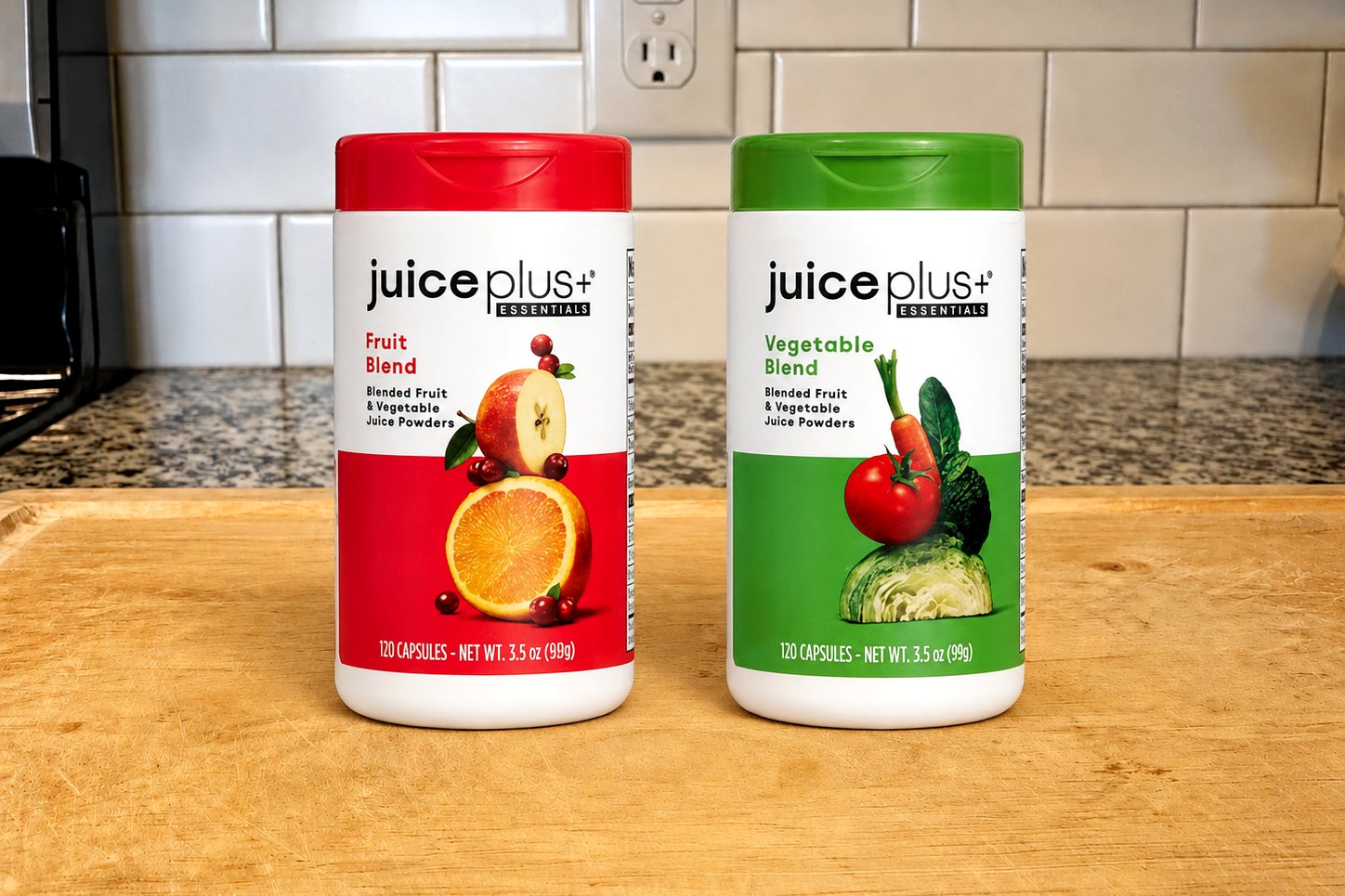
Juice Plus+ has been selling “the next best thing to fruits and vegetables” since 1993 — longer than some of its customers have been alive. It has something almost no competitor can claim: a stack of published human trials and a real NSF certification.
So here’s the question that decides whether any of that matters: how much of each fruit and vegetable is actually in the four daily capsules?
We checked the label, the pricing, the research file and regulatory records from Washington to Rome to Canberra. The answer to that question hasn’t changed in thirty years — and it’s why the most-credentialed produce capsule on the market still only scores 50 out of 100.
At a glance
Quick verdict
Juice Plus+ Fruit & Vegetable Blend is the strongest label in the TV-produce-capsule category — which tells you more about the category than the label. The NSF certification is real and meaningful: an independent program verified manufacturing quality and that the product contains what the label states. The problem is what the label states: two juice-powder blends with 23 named plants and no amount for any of them. Thirty-three clinical trials can’t fix a label that won’t say what dose it delivers.
Add the way it’s sold — a distributor network whose health and income claims have drawn an FTC warning letter, a €1 million Italian fine and a 2023 self-regulatory case that flagged 112 social posts — and you get a product we can respect in parts and still not recommend. If you’ve decided you want capsule produce, this is the better-credentialed option at the lower price. We’d still rather you bought a label that shows its numbers.
A consistent summary of formula, transparency, value and experience. Not a medical rating.
Scores follow our published 100-point methodology, applied identically to every product. View the scoring methodology.
May suit you if
- You’ve decided on capsule-format produce and want the option with a real, verifiable certification behind its manufacturing
- A four-capsule day and a set-and-forget subscription fit how you actually live
- An imperfect research file matters more to you than disclosed plant amounts
Skip it if
- You want to know how much of each plant you’re taking — after thirty years, this label still won’t say
- Buying through an MLM distributor network is a dealbreaker for you
- $648 a year is produce-aisle money to you — because it is
Plain Google search link — not an affiliate link. The Ingredient Report earns nothing if you purchase this product.
Key findings
Product specifications
| Format | Capsules — two blends (Fruit + Vegetable), shipped as 4 bottles per 4 months |
|---|---|
| Serving size | 2 capsules per blend per day (4 total) |
| Price (checked July 14, 2026) | $54.00/mo subscription · $216.00 one-time (4-month supply) |
| Cost per day | $1.80 |
| Fruit blend | Apple, peach, cranberry, orange, mango, acerola cherry, pineapple, prune, date, beet, lemon peel + plant-based vitamins |
| Vegetable blend | Broccoli, parsley, tomato, carrot, garlic, acerola cherry, beet, spinach, cabbage, kale, rice bran, lemon peel + plant-based vitamins |
| Individual plant amounts disclosed | No |
| Certifications | NSF quality & safety; NSF gluten-free; non-GMO; kosher |
| Subscription terms | Billed $216 per 4-month shipment; company states "cancel anytime" |
What’s in four capsules? The blend question, thirty years on
The ingredient lists are genuinely respectable: 23 named fruits and vegetables across the two blends, in juice-powder concentrate form, with added plant-derived vitamins (beta-carotene, vitamin C, vitamin E, folate) whose amounts are stated on the Supplement Facts panel. That partial disclosure is why dosage scores 8/20 here against the 6/20 we gave Balance of Nature — some numbers beat no numbers.
But the numbers that matter are still missing. How much broccoli powder? How much kale? The blends don’t say — not per ingredient, and the physics is unforgiving: four standard capsules hold roughly three grams of powder, split 23 ways. Dietary guidance describes produce intake in hundreds of grams a day. Whatever those four capsules deliver, the label gives you no way to know it, compare it or hold the company to it.
One more wrinkle the marketing glosses over: these are juice powder concentrates — the fiber that makes produce produce is largely gone, which the added-vitamin fortification quietly concedes. Formula scores 13/25: real plants, honest concept, fortified and undisclosed execution.
The 33-study question: what does the research actually show?
Juice Plus+’s best marketing asset is real: 33 human clinical trials, 48 published papers, some in respectable journals. No competitor in this category comes close, and our methodology gives credit for that — it’s part of why this product outscores its TV rival by 15 points.
Now the part the brochures skip. The research is overwhelmingly company-funded. Key studies involved researchers with financial ties to the company — including a research VP who came from an MLM shut down in the 1980s over illegal health claims. Independent evaluators are blunt: Science-Based Medicine calls it “good marketing, not good science”; Memorial Sloan Kettering describes a pricey supplement marketed with exaggerated value. And in 2023, the Direct Selling Self-Regulatory Council reviewed 112 flagged distributor posts claiming benefits from blood pressure to cognition to kids missing fewer school days — and found the claims lacked adequate substantiation, classifying the company’s “Healthy Starts” survey data as anecdotal.
Our read: the trials establish that the product raises blood levels of some vitamins and carotenoids — which fortified capsules should. They do not establish the health outcomes the distributor network sells. Funded evidence of absorption is not independent evidence of benefit.
Certification vs. transparency — credit where it’s due
This is the category’s best testing story, and we score it that way: 12/20. NSF certification for quality and safety is a real, independent, auditable program — it verifies manufacturing standards and that the contents match the label. The gluten-free, non-GMO and kosher marks are similarly programmatic rather than self-declared. After reviewing a category where “third-party tested” usually means a badge someone drew in Photoshop, this is genuinely better.
What holds the score under 15: no published batch certificates of analysis, and the certification can only verify what the label says — and the label doesn’t say the plant amounts. NSF can confirm the powder is what the company says it is; it can’t tell you how much powder of each plant there is, because nobody wrote that down. And history keeps a footnote: in 2011, ConsumerLab’s independent test measured one blend at 76.4% of its claimed calcium.
The regulatory record: three continents, one pattern
The product has never been the regulatory problem — the selling has. Juice Plus+ has moved through a multi-level marketing structure since 1993 (National Safety Associates, founded 1970), and the distributor network’s enthusiasm keeps outrunning the evidence. June 2020: an FTC warning letter over distributors marketing the product as a COVID-19 defense and overstating earnings. 2019: Italy’s competition authority fined the company €1 million over fake testimonials and disease claims across Italy, Germany and the UK. February 2020: Australia’s TGA issued penalties over unauthorized health-professional endorsements. 2023: the DSSRC case above — 71 of 112 flagged posts removed after inquiry.
The pattern matters more than any single case: when a product’s sales force is paid on recruitment and enthusiasm, the claims inflate, and regulators keep having to let the air out. Brand & customer experience scores 4/10 — the certifications and thirty-year track record earn points; the enforcement file and BBB complaint themes (billing, cancellation, distributor conduct) take them back.
The math: $1.80 a day, billed $216 at a time
$216 per four-month shipment works out to $54 a month, $1.80 a day, about $648 a year. In this category that’s mid-priced: 40% below Balance of Nature’s $3.00/day, but still well above disclosed-amount produce and greens products that run $1.00–$1.50 per serving. Note the billing rhythm: “$54 a month” is the marketing frame, but your card sees $216 at a time — worth knowing before you subscribe, and a recurring theme in billing complaints.
Against actual food, the comparison ends the way it always does: $1.80 buys a lot of frozen spinach and bananas, with fiber included and full disclosure by nature. Value scores 7/15.
What customers report
We read customer feedback across the major platforms and summarize the recurring themes. We don’t republish other platforms’ reviews — check the live sources yourself:
Trustpilot
Mixed reviews
Positives on routine/convenience; recurring negatives on billing and results expectations.
View live reviews →Better Business Bureau
Recurring complaints
Dominant themes: subscription billing, cancellation, distributor conduct.
View complaint record →DSSRC (BBB National Programs)
112 posts flagged, 2023
Self-regulatory case over distributor health & earnings claims; 71 removed.
Read the case →Recurring positives
- Simple four-capsule routine; no taste, no mixing
- Long-running brand; many multi-year customers
Recurring negatives
- $216 shipment billing surprises; cancellation friction
- Results not matching distributor promises
- Buying-from-a-friend pressure baked into the sales model
We don't fact-check or verify individual customer reviews — reviewers' opinions and experiences are their own, and we never treat them as evidence that a product works or doesn't. What we do: read feedback at scale across named platforms, report only the themes that recur, and link the live sources so you can judge the raw material yourself.
Every factual claim on this page that is ours — prices, label contents, regulatory records — carries a checked date and a source. Spot an error? Tell us and we'll correct it under our corrections policy.
Reader reports · 0 so far
Share your experienceRight of reply: The Juice Plus+ Company is welcome to respond to this report on the record. Contact our editorial team — responses are published unedited alongside this review.
What to buy instead
Same checklist we apply everywhere, and the one this product half-passes: (1) the label states the amount of every ingredient per serving — Juice Plus+ states vitamins only; (2) testing documentation is published and verifiable — the NSF marks pass this test; (3) the cost lands under roughly $2 per serving — $1.80 squeaks by. Two of three is the best result in the TV-capsule field, and still not a recommendation, because the test that matters most is the one it fails. For the head-to-head against its main rival, see Balance of Nature vs Juice Plus+.
Final assessment
Juice Plus+ is what happens when a secretive category gets a competent operator: real certifications, real published trials, a functional product — wrapped around the same undisclosed-blend core and sold through a distributor machine that regulators on three continents have had to correct. The 50/100 gives full credit for the NSF marks and the research file, and full penalty for the missing plant amounts, the self-funded evidence and the enforcement record. If you buy in this category, this is the more accountable of the famous names. Our actual advice hasn’t changed: a label that states its amounts — or the produce aisle — beats both. Individual needs and results vary; if you're considering supplements for a health condition, talk with your healthcare provider first.
Frequently asked questions
How much does Juice Plus+ cost per month?
As of July 14, 2026, the Fruit & Vegetable Blend costs $54.00 per month on subscription — but note it's billed $216.00 per four-month shipment. That's $1.80 per day, about $648 per year.
Does Juice Plus+ disclose ingredient amounts?
Partially. Added plant-derived vitamin amounts appear on the Supplement Facts panel, but the fruit and vegetable blends disclose no per-ingredient amounts — you cannot determine how much of any named plant a serving contains.
Is Juice Plus+ third-party tested?
At the certification level, yes: NSF certifies the capsules for quality and safety, plus gluten-free, non-GMO and kosher programs. Batch-level certificates of analysis are not published.
Do the clinical studies prove Juice Plus+ works?
The trials show the product raises blood levels of certain vitamins and carotenoids. They are largely company-funded, and independent evaluators conclude they don't establish the marketed health benefits. A 2023 industry self-regulatory case found numerous distributor claims lacked adequate substantiation.
Is Juice Plus+ an MLM?
Yes — it has been sold through a multi-level marketing structure since 1993. The FTC sent the company a warning letter in June 2020 over distributors' COVID-19 treatment claims and income representations.
The Label Brief — free weekly report
Before the next subscription charges your card, read the label with us
Every week we put one supplement label, one price claim and one "as seen on TV" promise under the same microscope. One five-minute email. No hype, no sponsored scores — that's the whole point.
Get The Label Brief free →How we scored this product
Every product is scored with the same public 100-point methodology: formula and ingredient quality (25%), dosage and label transparency (20%), testing and manufacturing transparency (20%), value (15%), product experience (10%) and brand and customer experience (10%). Commercial relationships never add points. Read the full methodology.
Sources
- Juice Plus+ — Fruit & Vegetable Blend Capsules product page (price, serving, blends, certifications, subscription terms). Checked July 14, 2026. us.juiceplus.com
- U.S. Federal Trade Commission — warning letter to The Juice Plus+ Company LLC regarding COVID-19 efficacy and earnings claims, June 2020.
- Autorità Garante della Concorrenza e del Mercato (Italy) — €1,000,000 sanction over misleading testimonials and health claims, 2019.
- Australian Therapeutic Goods Administration — infringement notices regarding unauthorized endorsements, February 2020.
- BBB National Programs, Direct Selling Self-Regulatory Council — Case #115-2023, The Juice Plus+ Company, LLC (112 flagged posts; substantiation findings), closed May 2023.
- ConsumerLab — independent testing of Juice Plus+ Garden Blend (76.4% of claimed calcium), 2011.
- Science-Based Medicine — "Juice Plus+: Good Marketing, Not Good Science" (research-quality analysis).
- Memorial Sloan Kettering Cancer Center — integrative medicine entry on Juice Plus (evidence evaluation).
- Wikipedia — Juice Plus (company history, NSA/MLM structure, research-funding criticism). Accessed July 14, 2026.
- Better Business Bureau — The Juice Plus+ Company complaint records (billing and cancellation themes). Accessed July 14, 2026.
Update history
- July 14, 2026 — Report first published. Formula, price and policy facts checked this date.
Content is for informational purposes only and is not medical advice. Individual needs and results vary. Medical disclaimer.