
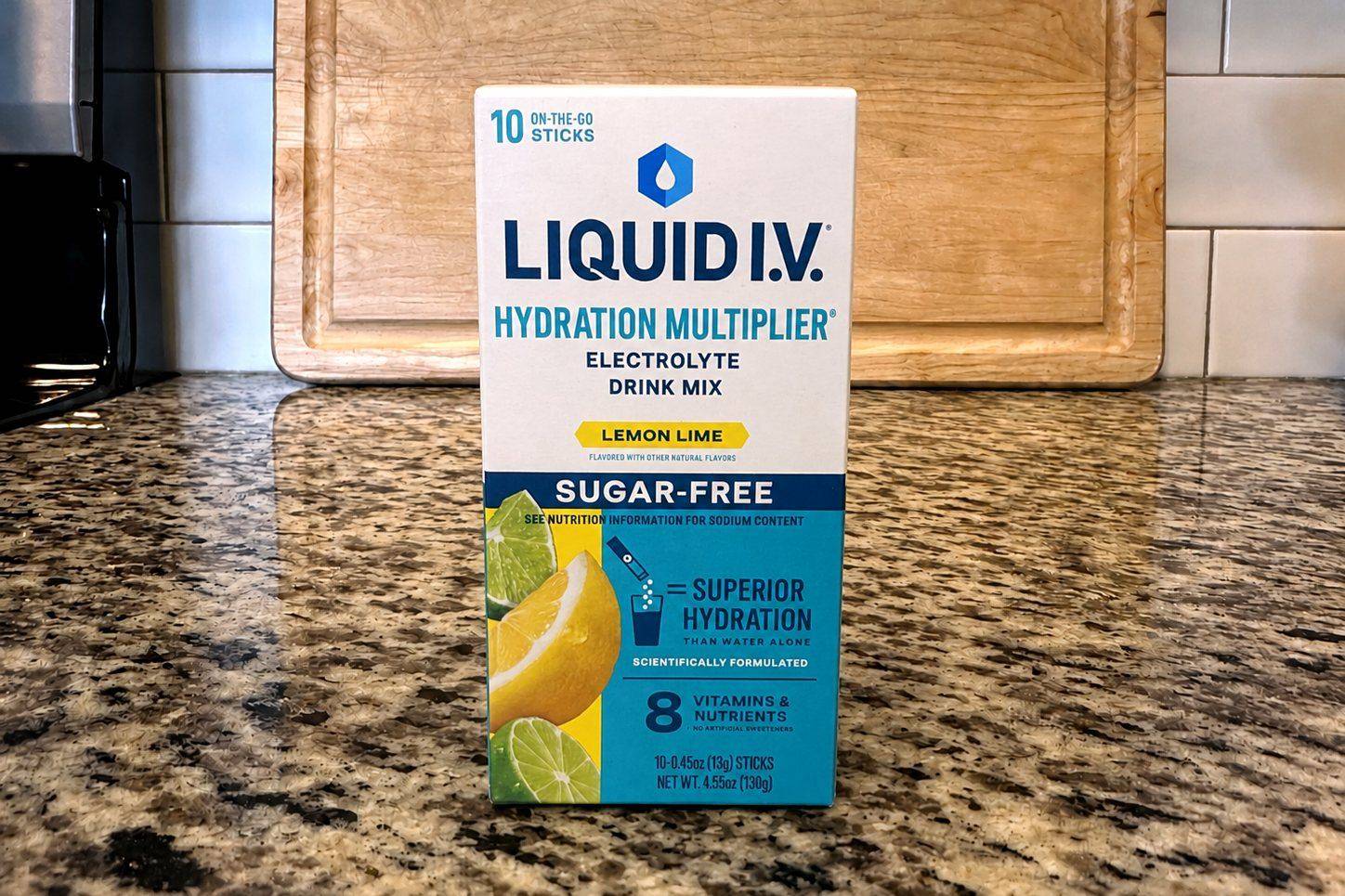
Liquid I.V. is how hydration became a checkout-aisle category: a cheerful stick, a vaguely medical name, and a claim to hydrate “faster than water alone” via something called Cellular Transport Technology.
Here’s the demystification that decides this review: that technology is glucose — sugar, pulling sodium and water across the gut wall, the same co-transport mechanism behind the medical oral rehydration solutions that save lives worldwide. It’s real science. It also means the sugar isn’t an additive; it’s the engine — 11 grams of it per stick. Score that honestly for what most buyers actually do with this product, and you get 51/100.
At a glance
Quick verdict
As a purpose-built tool — illness, long flights, brutal heat, genuine dehydration — Liquid I.V. is a reasonable consumer version of a medical idea, with disclosed amounts and the best potassium number in our comparison. Used that way, occasionally, the sugar is the point and the product delivers.
As the daily habit its marketing and its subscription model encourage, the math turns against it: 11 g of added sugar every day for hydration most people can get from water and food, at ~$1.50 a serving, with a B-vitamin garnish that mostly decorates the panel and no named certification behind the label. 51/100 — the lowest score in our electrolyte series, for the gap between what it is and how it’s sold.
A consistent summary of formula, transparency, value and experience. Not a medical rating.
Scores follow our published 100-point methodology, applied identically to every product. View the scoring methodology.
May suit you if
- You want an ORS-style product for acute situations — illness, flights, extreme heat — and the sugar is a feature
- Potassium matters most to you: ~390 mg is the field’s best
- You want it today — no product in the category is easier to find at retail
Skip it if
- You’re building a daily habit — 11 g of added sugar a day is a real dietary line-item
- You’re sugar-conscious, diabetic or low-carb — zero-sugar rivals cover every use case but the ORS one
- You compare per milligram of sodium — 29¢ per 100 mg is the field’s worst rate
Plain Google search link — not an affiliate link. The Ingredient Report earns nothing if you purchase this product.
Key findings
Product specifications
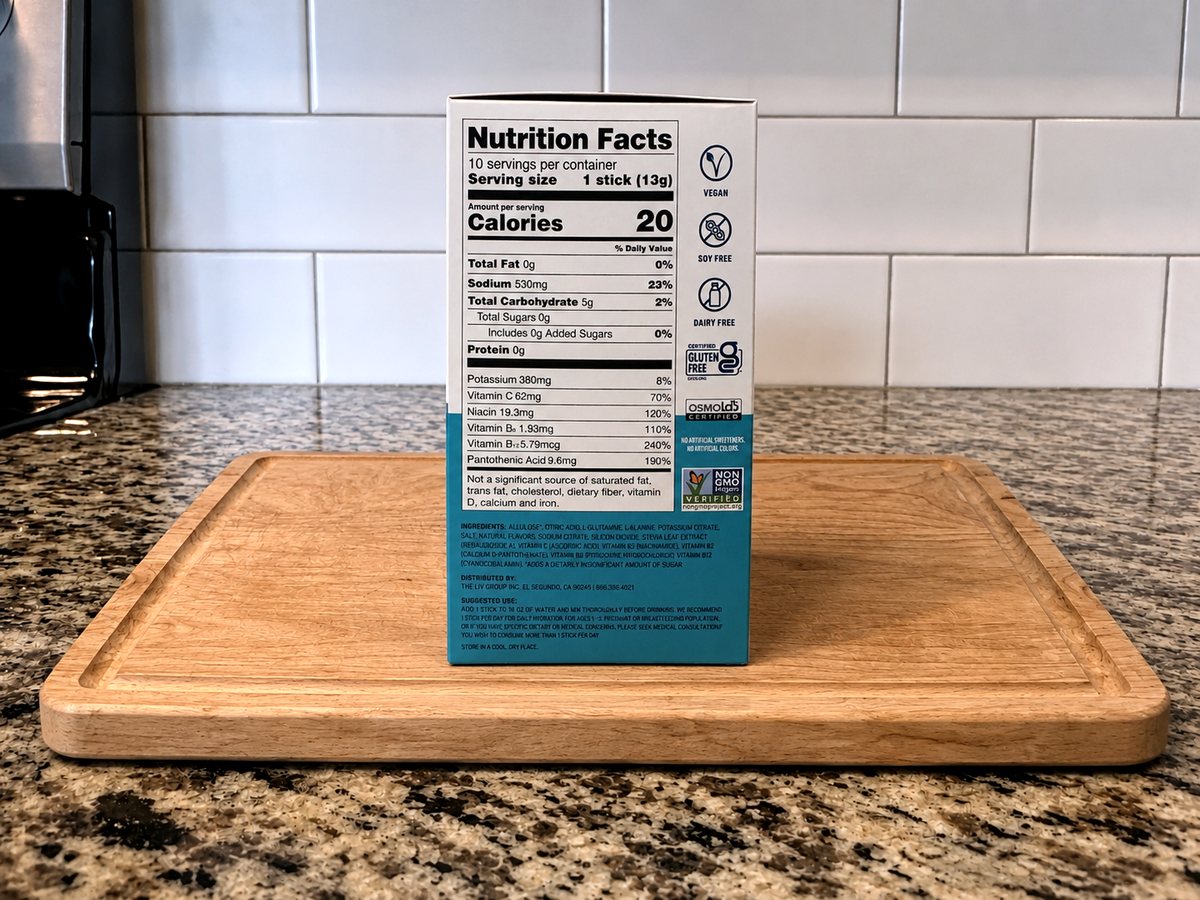
Update, July 17, 2026 — we bought the Sugar-Free variant. This review covers the classic Hydration Multiplier and its deliberate 11 g of sugar; the box on our counter is its sugar-free sibling, and the printed panel documents how the brand solved the no-sugar problem: a 13 g stick with 20 calories, 530 mg sodium, 380 mg potassium, 0 g sugar — sweetened with allulose and stevia, with L-glutamine and L-alanine standing in for glucose in the transport story, plus the same B-vitamin stack (The LIV Group, El Segundo, CA). If the 11 g of sugar is what stops you but the ORS approach appeals, this variant exists — we have not scored it separately.
| Format | Single-serving stick packs, many flavors |
|---|---|
| Servings per box | 16 (retail multipacks vary) |
| Price (checked July 2026) | ~$24 (~$17.49 subscription) |
| Cost per serving | ~$1.50 ($1.09 sub) |
| Electrolytes per stick | Na ~510 mg · K ~390 mg |
| Added sugar | 11 g (cane sugar + dextrose — the functional core) |
| Also included | Vitamin C, B3, B5, B6, B12; stevia; natural flavors |
| Stated testing | No named independent certification found |
| Parent company | Unilever (acquired 2020) |
The formula: the sugar is the engine
Credit first: this is a coherent product. Oral rehydration science is one of public health’s great achievements, and Liquid I.V. is a flavored consumer adaptation of it — glucose and sodium in ratios that genuinely accelerate fluid absorption when you’re meaningfully dehydrated. The potassium number is the best in our comparison, and every amount is printed. Dosage & transparency: 14/20.
The formula score is where the framing costs it. For the marketed use — daily “better than water” hydration — 11 g of added sugar is a nutritional price the category’s zero-sugar options simply don’t charge, the B vitamins are panel decoration at these doses, and the ~1.3:1 Na:K ratio inverts what most electrolyte-replacement guidance looks for. A product this well-built for the acute case, sold this hard for the daily case, scores 12/25 on formula — the mismatch, quantified.
The testing column
Unilever-scale manufacturing brings mass-retail quality systems, and we found no contamination or recall record in our review. But our testing score pays for what a shopper can verify, and there is no NSF, Informed Sport or equivalent named certification on the listing, no published COAs, no checkable program (checked July 2026). In a comparison where LMNT’s certification is batch-checkable in a public database, that’s 6/20 — the field’s lowest testing mark, from its biggest company. The offer stands as always: certify, publish, and we re-score on the record.
What it’s like to take
We have not yet run our own hands-on trial; reported themes are the most uniform in the category: it tastes like a sweet beverage (because it is one), dissolves fast, and delivers a noticeable pick-up in genuinely depleted states — post-illness, post-flight, hangovers, heat. That’s the ORS engine doing its job. Experience: 7/10, with the note that “tastes great daily” is exactly the property that makes an 11 g-sugar habit easy to acquire.
The math: premium price, sweetest fine print
~$24 ÷ 16 = ~$1.50 a serving ($1.09 on subscription; warehouse multipacks run lower). Daily for a year: ~$400–$548 — plus roughly 4 kg of added sugar, a number no other product in our comparison asks you to swallow. Per 100 mg of sodium it’s ~29¢, the field’s highest. Value: 6/15 — fair for an occasional-use tool, poor for the daily habit it’s marketed as.
Returns and where to buy
Sold direct (subscription available) and at essentially every mass retailer — Costco, Target, Walmart, Amazon — where retail return policies apply and per-stick prices often beat the brand site. No notable policy or complaint pattern surfaced in our review (checked July 15, 2026).
What customers report
We read customer feedback across the major platforms and summarize the recurring themes. We don’t republish other platforms’ reviews — check the live sources yourself:
Mass-retail reviews
Strongly positive
Enormous volume; positives on taste and post-illness/hangover recovery, negatives on sweetness and sugar content.
View live reviews →Better Business Bureau
Profile on file
A BBB profile exists (El Segundo, CA); no complaint pattern of note surfaced in our July 15, 2026 review.
View the BBB record →Dietitian & testing outlets
Split verdicts
Reviewers consistently validate the ORS mechanism and consistently flag the same two things we score: sugar and the daily-use framing.
Search expert reviews →We don't fact-check or verify individual customer reviews — reviewers' opinions and experiences are their own, and we never treat them as evidence that a product works or doesn't. We read feedback at scale, report recurring themes, and link the live sources.
Every factual claim on this page that is ours carries a checked date and a source. Spot an error? Tell us — corrections run under our corrections policy.
Reader reports · 0 so far
Share your experienceRight of reply: Liquid I.V. / Unilever is welcome to respond to this report on the record. Contact our editorial team — responses are published unedited alongside this review.
What to buy instead
If daily zero-sugar hydration is the actual goal, the full comparison maps the alternatives: LMNT (70/100) for the athlete dose with the category’s only checkable certification, and Nuun Sport (54/100) for the light-dose tablet. If it’s true ORS territory — real illness-level dehydration — talk to a pharmacist about medical-grade oral rehydration salts, which deliver the same mechanism for far less money.
Final assessment
Liquid I.V. is a good product wearing the wrong job description. As a consumer ORS for acute dehydration, it’s legitimate, effective and disclosed. As the daily wellness habit its marketing, flavors and subscriptions are engineered to create, it asks you to drink 11 grams of added sugar a day at a premium price with no named certification behind the panel — and that’s the product most of its buyers actually receive. 51/100: significant concerns, nearly all of them about the gap between the use case that justifies the formula and the one that sells it. Keep a few sticks for sick days; think twice before the subscription. If you’re diabetic, sugar-restricted or sodium-restricted, this label is a conversation with your doctor first.
Frequently asked questions
How much sugar is in Liquid I.V.?
11 g of added sugar per stick — about 44% of the AHA’s daily guidance for women — and it’s functional, not incidental: the glucose drives the product’s absorption mechanism.
Does it actually work?
The mechanism is real (glucose-sodium co-transport, the ORS principle). The better question is whether your situation needs it — acute dehydration yes, everyday desk hydration mostly no.
How much does it cost?
~$24/16 sticks (~$1.50/serving) one-time, ~$1.09 on subscription as of July 2026; mass-retail multipacks often cheaper. Per 100 mg of sodium: ~29¢, the field’s highest.
Is it third-party tested?
No named independent certification appears on the listing as of July 2026 — Unilever-scale manufacturing, but nothing a shopper can look up by batch.
The Label Brief — free weekly report
“Cellular Transport Technology” took us one paragraph to translate. Want next week’s translation first?
Every week we put one supplement label, one price claim and one viral promise under the same microscope. One five-minute email. No hype, no sponsored scores.
Get The Label Brief free →How we scored this product
Every product is scored with the same public 100-point methodology: formula and ingredient quality (25%), dosage and label transparency (20%), testing and manufacturing transparency (20%), value (15%), product experience (10%) and brand and customer experience (10%). Commercial relationships never add points. Read the full methodology.
Sources
- Liquid I.V. — Hydration Multiplier listings and label panel (electrolyte amounts, 11 g added sugar, ingredients incl. cane sugar and dextrose, B vitamins). Brand PDP re-verification pending (fetch blocked); figures corroborated via retail listings and a dietitian review updated February 2026. Checked July 2026.
- Pricing — ~$24/16 one-time, $17.49 subscription per the same February 2026 dietitian review; retail multipacks vary. Checked July 2026.
- American Heart Association — added-sugar guidance (~25 g/day for women) for the percentage context.
- Better Business Bureau — Liquid I.V. profile, El Segundo, CA (linked live). Checked July 15, 2026.
- The Ingredient Report — electrolyte category comparison and scored reviews of LMNT (70/100), Earth Energy (65/100) and Nuun (54/100), checked July 15, 2026.
Update history
- July 17, 2026 — We purchased the Sugar-Free Lemon Lime variant and photographed its panel (13 g stick, 20 cal, Na 530 mg, K 380 mg, 0 g sugar, allulose + stevia): documented above as an alternative for sugar-averse buyers. The classic 11 g-sugar original remains the scored product. Real product photography replaces the placeholder images.
- July 15, 2026 — Report first published. Facts checked July 2026 as noted; brand-site panel re-verification queued for the August check. We re-score on the record if certification appears or the formula changes.
Content is for informational purposes only and is not medical advice. For clinical dehydration, seek medical care — consumer drink mixes are not medical treatment. Medical disclaimer.