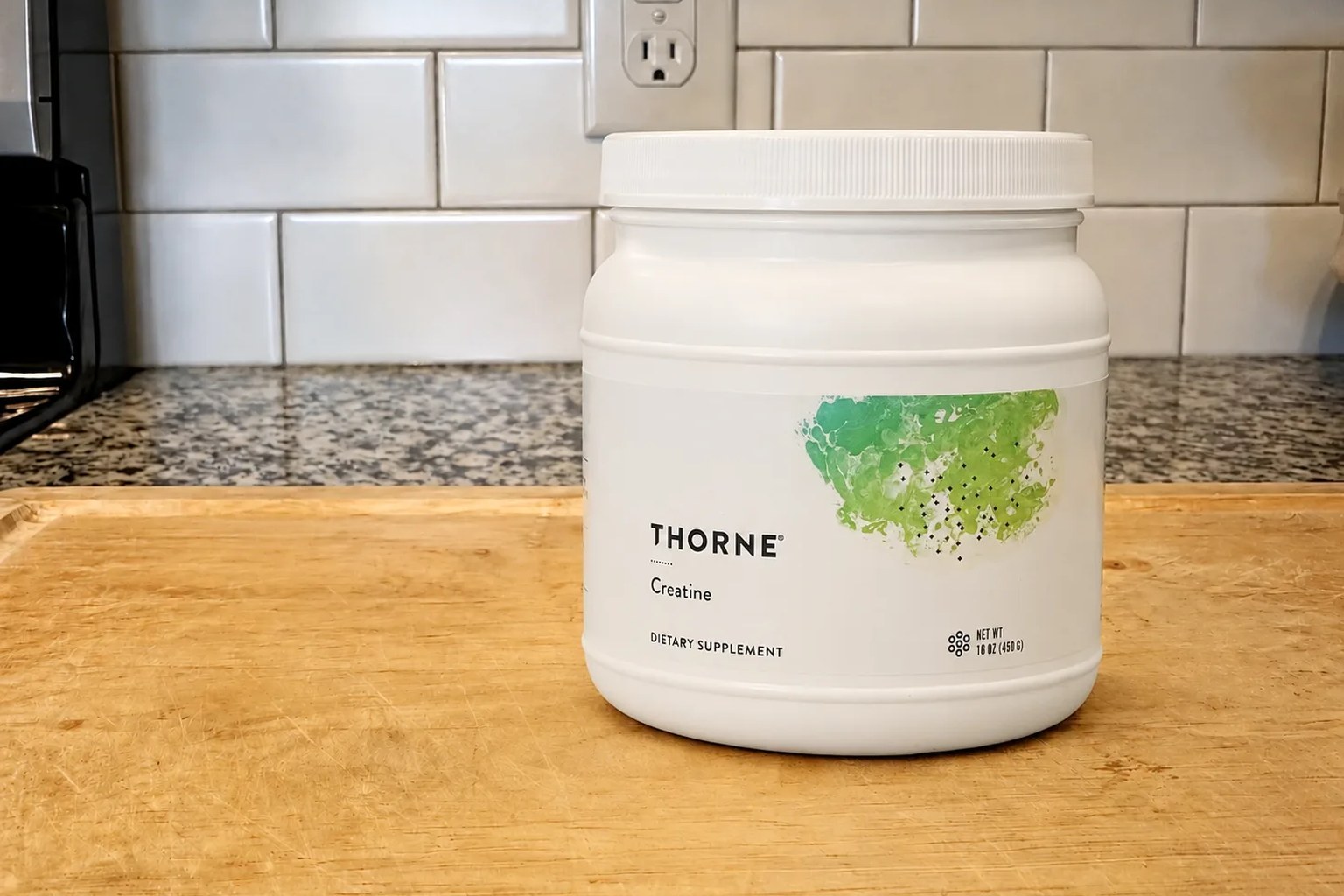
Thorne Creatine is about as simple as a supplement gets: one scoop, 5 g of micronized creatine monohydrate, a single ingredient, and nothing else in the tub. No blend, no flavor system, no proprietary anything. In most categories that would be a knock. In creatine it is the whole idea.
Here is why. Creatine monohydrate is simultaneously the most-studied, most-proven form of creatine and the cheapest to manufacture. Decades of trials point at the same molecule, and every serious product uses it. That collapses the competition: once a product delivers the clinical 5 g dose of monohydrate, there is essentially nothing left to compete on except two things — how well it is tested, and what it costs. This review turns on exactly those two axes. Here’s the full scorecard.
At a glance
Quick verdict
Thorne Creatine is the best overall pick in our creatine roundup, and the reasoning is almost boringly clean. The category rewards two things and only two things once the dose is right: proven form and real testing. Thorne delivers the proven form — 5 g of micronized monohydrate, single ingredient — and then wins the testing half outright with NSF Certified for Sport, confirmed on the public NSF database. That is the strongest credential in the category, and it is why this out-points every other creatine we scored.
What holds it at 85 — Acceptable — is the second axis: price. At roughly $0.49 a serving it costs about twice a mainstream monohydrate that puts the identical molecule in the identical dose. That is a real deduction, not a quibble, because the thing you are buying more of is not creatine — it is the certification. If you need NSF Certified for Sport, this is the premium done right and the money is well spent. If you don’t, a cheaper certified or well-tested monohydrate gets you the same result for less. Either way, the creatine in the scoop is the same creatine.
A consistent summary of formula, transparency, value and experience. Not a medical rating.
Scores follow our published 100-point methodology, applied identically to every product. View the scoring methodology.
May suit you if
- You want the single most credential-heavy creatine available — NSF Certified for Sport is the seal competitive and tested athletes are told to look for
- You value a dead-simple, single-ingredient 5 g monohydrate with nothing else in the tub, and you’ll pay a premium for the testing
- You want the category’s best-overall pick and the reassurance of a certification confirmed on a public third-party database, not just claimed on a label
Skip it if
- You’re price-sensitive and don’t need a sport certification — a mainstream monohydrate delivers the identical 5 g molecule for about half the cost
- You want the absolute cheapest cost per gram — budget monohydrate tubs run a fraction of Thorne’s per-serving price
- You expect a premium price to buy a better form of creatine — it doesn’t; monohydrate is monohydrate, and Thorne’s premium is the certification, not the molecule
Plain Google search link — not an affiliate link. The Ingredient Report earns nothing if you purchase this product.
Key findings
Product specifications
| Format | Powder, ~5 g scoop, 90 servings per tub (450 g) |
|---|---|
| Price (checked July 20, 2026) | ~$44 (90-serving tub) |
| Cost per serving | ~$0.49 (roughly twice a mainstream monohydrate) |
| Form | Micronized creatine monohydrate — the most-studied, most-proven form |
| Ingredients | One: creatine monohydrate. No blend, no flavor system, nothing else |
| Dose | 5 g per serving — the clinical dose |
| Independent testing | NSF Certified for Sport® — confirmed on the public NSF database |
| Made in | USA |
The formula: 5 g, one ingredient, the proven form
On the fundamentals, Thorne does exactly what our creatine rubric rewards and nothing it penalizes. It delivers 5 g of micronized creatine monohydrate — the clinical dose, in the most-studied and most-proven form — as a single ingredient, with no proprietary blend, no HMB or nitrate add-ons whose evidence is thinner, and no flavor system to pad the label. Micronization just means a finer powder that mixes more cleanly; it doesn’t change the molecule. In a category where the winning move is “hit the proven dose of the proven form and get out of the way,” this is close to a textbook formula — 22/25.
The reason it isn’t a perfect formula score is simply that there is no way to be better than clean monohydrate at 5 g — every serious competitor does the same thing, because the science points at the same molecule. That is the honest shape of this category: the formula is a solved problem, which is precisely why the real contest moves to testing and price.
The testing column
This is where Thorne separates from the field. It is NSF Certified for Sport® — a batch-level certification that tests for heavy metals, microbial contamination and more than 280 banned substances, and the credential competitive athletes are specifically told to look for. Crucially, we didn’t just take the label’s word for it: the listing is confirmed on the public NSF database, which is the difference between a marketing claim and a verified certification. It is the strongest independent credential in the creatine category — testing 19/20, the highest mark we’ve given here, and it is earned.
Context matters for why that seal is worth so much. Several competitors carry weaker or vaguer assurances — a facility registration rather than a batch sport cert, an unnamed “third-party tested” claim, or a banned-substance program that isn’t NSF Certified for Sport. Thorne carries the gold standard and puts it on a database you can check, which is exactly the kind of verifiable testing this rubric is built to reward.
What it’s like to take
We have not yet run our own long-term trial — this is a research-based review in which we verified the formula, the single-ingredient label and the NSF Certified for Sport listing on the public database, and our hands-on mix-and-take testing is still pending, which we’d rather state plainly than imply otherwise. What we can report is the durable consensus: micronized monohydrate like this mixes cleanly and is essentially flavorless, which is what you want in a powder you’ll stir into water or a shake every day. There is no taste system to like or dislike, and creatine’s only common complaint — minor water retention or, rarely, stomach upset when loading too fast — is a property of the molecule, not of any one brand. Experience 8/10, and we’ll update it once our own trial is done.
The math: paying for the certification
Here is the whole value story in one line: a 90-serving tub runs about $44, which is roughly $0.49 a serving — and a mainstream micronized monohydrate delivering the identical 5 g of the identical molecule runs closer to $0.23 a serving. Thorne is about twice the price for creatine that is chemically the same. What the extra buys you is not better creatine; it is the NSF Certified for Sport batch certification, confirmed on a public database. That is a real thing worth real money if you compete in a tested sport or simply want the strongest assurance available — but it is emphatically not a better molecule. Value 10/15: the product is excellent, the price is premium, and the premium is entirely the certification.
Returns and where to buy
Sold through Thorne’s own site and major retailers rather than a subscription-first model, which spares you the usual auto-ship friction. As a sealed tub of single-ingredient powder the practical advice is ordinary: keep it dry and sealed so the powder doesn’t clump. No safety or quality red flags surfaced in our review, and the NSF Certified for Sport listing — verified on the public database — is a genuine point in its favor (checked July 20, 2026).
What customers report
We read customer feedback across the major platforms and summarize the recurring themes. We don’t republish other platforms’ reviews — check the live sources yourself:
Retail & DTC reviews
Broadly positive
Long-running high ratings; praise centers on clean mixing, trust in the brand and the sport certification — criticism centers almost entirely on price versus cheaper monohydrate.
View live reviews →NSF certification database
Confirmed listing
Thorne Creatine appears on the public NSF Certified for Sport database, which is the verification behind the seal rather than a brand claim, as of July 20, 2026.
Check the NSF database →Dietitian & expert coverage
Favorable on a premium
Experts consistently rate Thorne among the top creatines on the strength of its certification and clean single-ingredient formula, while noting you can get the same molecule for less — the same split this review scores.
Search expert reviews →We don't fact-check or verify individual customer reviews — reviewers' opinions and experiences are their own, and we never treat them as evidence that a product works or doesn't. We read feedback at scale, report recurring themes, and link the live sources.
Every factual claim on this page that is ours carries a checked date and a source. Spot an error? Tell us — corrections run under our corrections policy.
Reader reports · 0 so far
Share your experienceRight of reply: Thorne is welcome to respond to this review on the record. Contact our editorial team — responses are published unedited alongside this review.
What to buy instead
Because every product here is the same 5 g of monohydrate, the choice comes down to certification and price — and that’s exactly how our creatine roundup ranks them. If you want NSF Certified for Sport but at a slightly lower price, Momentous Creatine (82/100) is the other certified premium pick, though it recently swapped Creapure for an in-house “Signature Spec” purity standard worth scrutinizing. If you don’t need the sport seal, a value monohydrate saves real money for the identical molecule: Optimum Nutrition Micronized Creatine (81/100) is our best-value pick at roughly half Thorne’s per-serving cost, and Nutricost Creatine Monohydrate (79/100) is the outright cheapest by cost per gram. We’d steer you away from paying more for less proven extras: Create Creatine Gummies (69/100) are convenient and certified but under-dose at 4.5 g and cost six-to-eight times powder per gram, and Transparent Labs Creatine HMB (63/100) is the priciest here for a weak-evidence HMB add-on and no named certification. The short version: Thorne is the best if you want the gold-standard seal; if you don’t, a value monohydrate is the smarter buy. And to be plain: Earth Energy, the independently operated brand under common ownership with this site, makes no creatine product, so there is no in-house alternative to recommend here.
Final assessment
Thorne Creatine is the reassuring kind of high score: it does the fundamentals exactly right and then adds the one thing that actually separates products in this category. It delivers 5 g of micronized creatine monohydrate — the proven form — as a single ingredient with nothing else in the tub, and it carries NSF Certified for Sport, confirmed on the public NSF database, which is the strongest credential a creatine can hold. 85/100 — Acceptable, and the best overall pick in our comparison — held back only by a price roughly twice a mainstream monohydrate that puts the identical molecule in the identical dose. That premium buys you the certification, not better creatine, and whether it’s worth it comes down to one question: do you need the sport seal? If yes, this is the premium done right. If no, a value monohydrate gets you the same result for less. And if you take medications or have a kidney condition, run any new daily creatine past your doctor first.
Frequently asked questions
Is Thorne Creatine worth the money?
Thorne Creatine is the best overall pick in our creatine comparison, scoring 85/100: 5 g of micronized creatine monohydrate, a single ingredient, carrying NSF Certified for Sport — the gold-standard certification, confirmed on the public NSF database. But at about $0.49 a serving it costs roughly twice a mainstream monohydrate that delivers the identical molecule. Worth it if you need the sport certification; if you don’t, a cheaper certified or value monohydrate gets you the same result for less.
Is Thorne Creatine NSF Certified for Sport?
Yes — Thorne Creatine is NSF Certified for Sport, and we confirmed the listing on the public NSF database rather than taking the label’s word for it. That’s a batch-level certification testing for heavy metals, contaminants and banned substances, the strongest independent credential in the creatine category and the main reason Thorne scores 19/20 on testing.
How much does Thorne Creatine cost per serving?
Checked July 20, 2026: about $44 for a 90-serving tub, which works out to roughly $0.49 a serving at 5 g per serving. That’s premium — about twice what a mainstream micronized monohydrate charges for the identical molecule — and the premium is the NSF certification, not a better form of creatine.
Is Thorne Creatine better than cheaper creatine?
Not in the creatine itself. Thorne uses creatine monohydrate, the most-studied and most-proven form, and so do the cheaper picks — monohydrate is monohydrate at the same 5 g dose. What Thorne adds is NSF Certified for Sport, the gold-standard batch certification. If you need that seal, Thorne is the premium done right; if you don’t, a value monohydrate delivers the same result for about half the price.
The Label Brief — free weekly report
The premium creatine, honestly scored. Want next week’s label math first?
Every week we put one supplement label, one price claim and one viral promise under the same microscope. One five-minute email. No hype, no sponsored scores.
Get The Label Brief free →How we scored this product
Every product is scored with the same public 100-point methodology: formula and ingredient quality (25%), dosage and label transparency (20%), testing and manufacturing transparency (20%), value (15%), product experience (10%) and brand and customer experience (10%). Commercial relationships never add points. Read the full methodology.
Sources
- Thorne — official product and pricing pages (5 g micronized creatine monohydrate, single ingredient, 90 servings per tub, ~$44, made in USA). Checked July 20, 2026. thorne.com
- NSF — public Certified for Sport database listing confirming Thorne Creatine’s certification (batch-level testing for heavy metals, contaminants and banned substances). Verified July 20, 2026. nsfsport.com
- The Ingredient Report — creatine category comparison and scored reviews of Momentous Creatine (82/100), Optimum Nutrition Micronized Creatine (81/100), Nutricost Creatine Monohydrate (79/100), Create Creatine Gummies (69/100) and Transparent Labs Creatine HMB (63/100). Checked July 20, 2026.
- Retailer and dietitian coverage (ratings, mixability and price-versus-cheaper-monohydrate themes; linked live, not republished). Accessed July 20, 2026.
Update history
- July 20, 2026 — Report first published. Formula, single-ingredient label, NSF Certified for Sport listing (confirmed on the public NSF database) and pricing checked this date; hands-on trial pending. We re-score on the record if Thorne changes the formula or dose, its certification status changes, or its pricing changes materially.
Content is for informational purposes only and is not medical advice. Talk with your healthcare provider before starting a daily creatine supplement, especially if you take medications or have a kidney condition. Medical disclaimer.