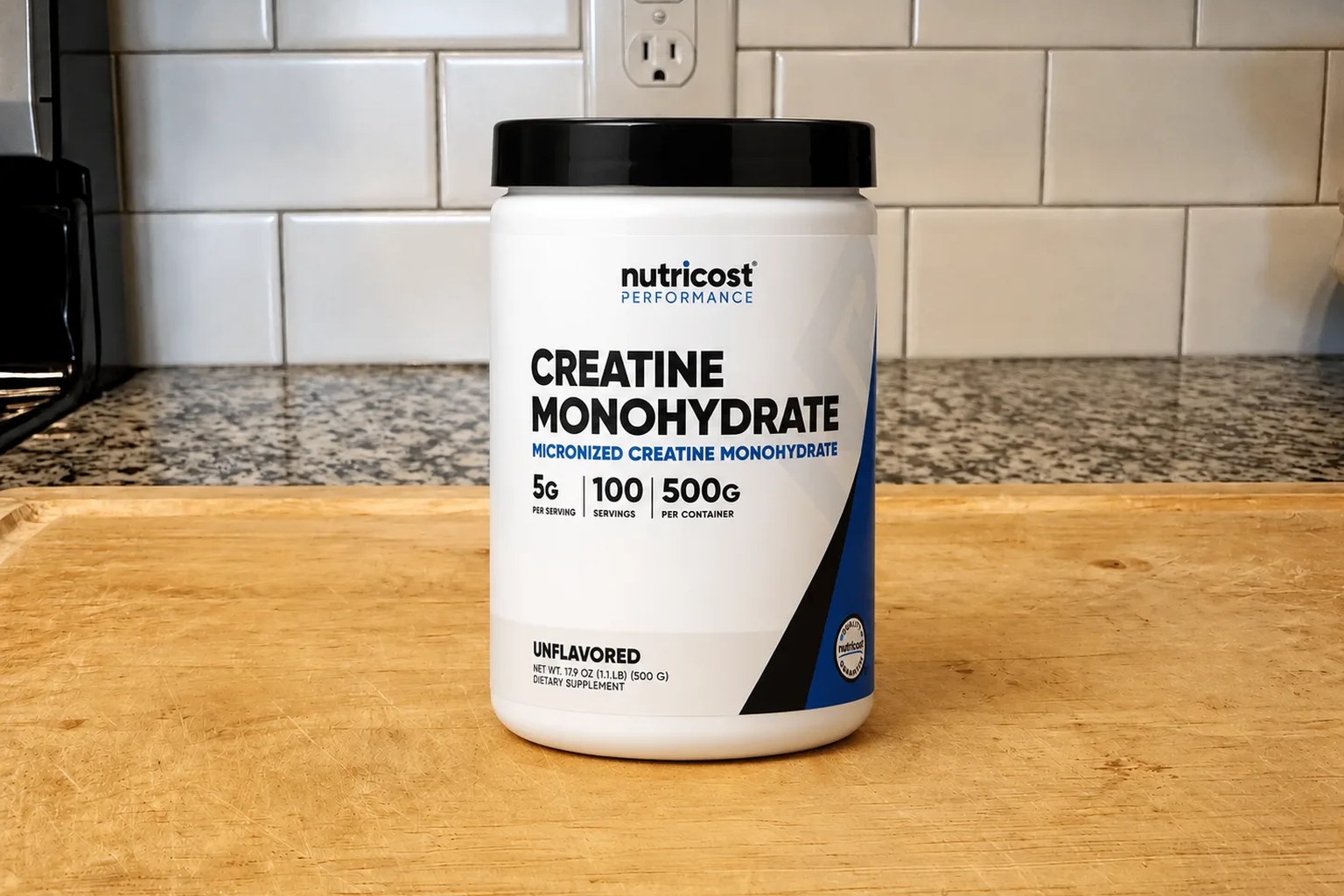
Nutricost Creatine Monohydrate is the answer to a simple question: what is the least you can pay for the exact molecule the research is built on? Creatine monohydrate is the single most studied sports supplement there is, and the effective dose — 5 g a day — has been settled science for decades. Nutricost gives you that and nothing else: one ingredient, micronized for easier mixing, no fillers, no proprietary blend, no flavor system to pay for.
The whole case for this product is the price. A 100-serving tub runs about $19, which is roughly three to four cents per gram of creatine — the cheapest honest way to buy the proven form. This review turns on two checkable things: whether the formula really is the same molecule at the same dose as the pricier picks (it is), and what you give up on the testing side to get there. Here’s the full scorecard.
At a glance
Quick verdict
Nutricost Creatine Monohydrate is the value pick of the category, and it earns that spot honestly. The formula is not a cheaper imitation of the good stuff — it is the good stuff: 5 g of micronized creatine monohydrate, one ingredient, no fillers, the same molecule at the same clinically studied dose as products that cost two and three times as much. At roughly three to four cents a gram of creatine it is the least expensive way in our comparison to take the most evidence-backed supplement there is. Formula 21/25, transparency 18/20, and a category-topping value of 15/15.
What keeps it at 79 — Acceptable — is the testing column, and it is a specific, honest deduction rather than a knock on the creatine itself. Nutricost says “third-party tested” and manufactures in a GMP-compliant, FDA-registered, NSF-registered facility — all real, all reassuring for an everyday buyer. But an NSF-registered facility is not the per-batch NSF Certified for Sport mark, and Nutricost carries no named athlete certification. If you are drug-tested, that gap is the whole ballgame and you should pay up for a certified option. If you are not, this is the smart-money buy: the proven molecule, the proven dose, the lowest price on the shelf.
A consistent summary of formula, transparency, value and experience. Not a medical rating.
Scores follow our published 100-point methodology, applied identically to every product. View the scoring methodology.
May suit you if
- You want the most evidence-backed supplement there is — creatine monohydrate at the proven 5 g dose — for the lowest honest price in the category
- You value a clean, single-ingredient label with no fillers and no proprietary blend, and you don’t need a banned-substance certification
- You’re cost-conscious and taking creatine for general training, health or longevity rather than competing in a drug-tested sport
Skip it if
- You compete in a drug-tested sport — a generic “third-party tested” claim and an NSF-registered facility are not the per-batch NSF Certified for Sport mark you need
- You specifically want a named batch certification (NSF Certified for Sport or Informed Choice) printed on the tub — Nutricost carries neither
- A California Prop 65 lead notice on the label is a dealbreaker for you, even though it’s common across creatine and mineral powders
Plain Google search link — not an affiliate link. The Ingredient Report earns nothing if you purchase this product.
Key findings
Product specifications
| Format | Micronized powder; 5 g scoop, 100 servings per 500 g tub |
|---|---|
| Price (checked July 20, 2026) | ~$19 (500 g tub) |
| Cost per serving | ~$0.19 (about 3–4¢ per gram of creatine) |
| Creatine form | Creatine monohydrate, micronized — the proven form |
| Dose | 5 g of creatine per serving (the clinically studied amount) |
| Other ingredients | None — single ingredient, no fillers, no proprietary blend |
| Independent testing | Generic “third-party tested” claim; NSF-registered facility — not NSF Certified for Sport |
| Made in | GMP-compliant, FDA-registered, NSF-registered facility |
| Warnings | California Prop 65 lead notice (common for creatine/mineral powders) |
The formula: the proven molecule, nothing added
There is very little to argue with here, because there is very little in the tub. Nutricost delivers 5 g of creatine monohydrate per serving — the exact form and the exact dose that decades of research are built on — and it is micronized, meaning the particles are ground finer so the powder mixes more easily and grits less. There is no second ingredient: no filler, no flavor system, no proprietary blend, no “matrix.” You can read the creatine dose straight off the panel because the creatine is the panel. Formula 21/25, transparency 18/20.
It is worth being clear about what “the same molecule” means, because it is the whole value case. Creatine monohydrate from a budget brand and creatine monohydrate from a premium brand are the same compound; the meaningful differences are dose (identical here at 5 g), purity and the strength of the testing behind it. Nutricost matches the leaders on the first two. Where it gives ground — and where the point comes off — is the third, which we take up next.
The testing column
This is the one column where Nutricost gives up ground, and it is worth stating precisely rather than overstating. Nutricost says its creatine is “third-party tested” and is made in a GMP-compliant, FDA-registered, NSF-registered facility. All of that is real and reassuring for an everyday buyer — it speaks to manufacturing controls and clean production. But read it carefully: an NSF-registered facility is not the same as the per-batch NSF Certified for Sport mark. Facility registration means the plant meets NSF’s facility standards; NSF Certified for Sport means each finished batch is tested for banned substances and contaminants and carries a named certification an athlete can verify. Nutricost holds no such per-batch mark, and no named athlete certification.
For most people buying creatine — for training, general health or longevity — that distinction genuinely does not matter, and the generic third-party claim plus a registered GMP facility is adequate. For a drug-tested athlete it matters a great deal, because only a batch-level certification like NSF Certified for Sport or Informed Choice tests the actual product going in the tub for banned substances. Our advice is plain: if you are subject to drug testing, step up to a certified option. That gap — a real but unnamed testing story rather than a batch sport certification — is why testing lands at 12/20. To be clear about what we have and haven’t checked: we photographed the label and verified the form, dose, facility claims and Prop 65 notice as of July 20, 2026. No safety or quality red flags surfaced in our review.
What it’s like to take
We have not yet run our own long-term trial — we photographed the label, and our hands-on mixability-and-tolerance testing is still pending, which we’d rather say plainly than pretend otherwise. What we can report is the durable consensus for micronized creatine monohydrate in this format: it is essentially flavorless, the micronized grind mixes into water or a shake more cleanly than coarser creatine, and it is one of the easiest supplements to simply stir in and forget. The only common gripe with any plain creatine powder — a little grit or slow dissolving in cold water — is exactly what micronizing is meant to reduce. Take 5 g a day, every day, consistency being the whole game with creatine. Experience 7/10, and we’ll update it once our own trial is done.
The math: the cheapest creatine here
This is where Nutricost wins outright, and it is not close. A 500 g tub — 100 servings at 5 g each — runs about $19, which is roughly $0.19 a serving, or about three to four cents per gram of creatine. That is the lowest per-serving and per-gram cost in our entire creatine comparison. For context, the mainstream value benchmark, Optimum Nutrition Micronized Creatine, runs about $0.23 a serving, and the certified premium picks — Thorne and Momentous — land near $0.48–$0.49, roughly two and a half times Nutricost’s number, for the same 5 g of the same molecule plus a batch certification. Because the molecule and the dose are identical, what you are paying extra for at those tiers is the testing and the brand, not better creatine. If price is the deciding factor and you don’t need a sport certification, there is no value objection to make here. Value 15/15 — the top of the band, earned.
Returns and where to buy
Widely available through major online retailers and Nutricost’s own channels as a straightforward one-time purchase rather than a subscription-first model, which spares you the usual auto-ship friction. Because it is a tub of powder rather than a sealed capsule bottle, the practical advice is ordinary pantry care: keep the scoop dry and the lid sealed so the powder doesn’t clump. The label carries a California Prop 65 lead notice, which is common across creatine and mineral powders. No safety or quality red flags surfaced in our review (checked July 20, 2026).
What customers report
We read customer feedback across the major platforms and summarize the recurring themes. We don’t republish other platforms’ reviews — check the live sources yourself:
Retail & DTC reviews
Broadly positive
Long-running high ratings across major retailers; praise centers on price, clean single-ingredient label and easy mixing — criticism centers on the lack of a named sport certification and on the Prop 65 notice.
View live reviews →Certification & testing
Facility registered, not batch-certified
Nutricost cites a GMP-compliant, FDA-registered, NSF-registered facility and a generic “third-party tested” claim, but no per-batch NSF Certified for Sport or Informed Choice mark, as of July 20, 2026.
Check the certifications →Dietitian & expert coverage
Favorable on value
Independent reviewers consistently name Nutricost among the best budget creatines for its 5 g monohydrate dose and rock-bottom cost per gram, while flagging the absence of a named sport certification — the same split this review scores.
Search expert reviews →We don't fact-check or verify individual customer reviews — reviewers' opinions and experiences are their own, and we never treat them as evidence that a product works or doesn't. We read feedback at scale, report recurring themes, and link the live sources.
Every factual claim on this page that is ours carries a checked date and a source. Spot an error? Tell us — corrections run under our corrections policy.
Reader reports · 0 so far
Share your experienceRight of reply: Nutricost is welcome to respond to this review on the record — particularly on per-batch banned-substance certification beyond the “third-party tested” claim and NSF facility registration. Contact our editorial team — responses are published unedited alongside this review.
What to buy instead
The one reason to spend more than Nutricost asks is testing, and it depends entirely on whether you are drug-tested. If you are not, the smart move is simply to buy Nutricost and pocket the difference — the molecule and the 5 g dose are identical up and down the category. If you want a bit more certification without paying premium prices, Optimum Nutrition Micronized Creatine (81/100) adds Informed Choice banned-substance testing for a little more per serving and is our best mainstream value. If you are a drug-tested athlete, step up to a per-batch NSF Certified for Sport option: Thorne Creatine (85/100) is our best certified pick overall, and Momentous Creatine (82/100) is the other NSF Certified for Sport choice — both roughly two and a half times Nutricost’s cost per gram for the same molecule plus the certification. The full field, ranked on our rubric, is in the creatine roundup, and if you just want to understand the ingredient before you buy, start with our creatine guide. And to be plain: Earth Energy, the independently operated brand under common ownership with this site, makes no creatine product, so there is no in-house alternative to recommend here.
Final assessment
Nutricost Creatine Monohydrate is the confident kind of Acceptable: the most evidence-backed supplement there is, in its proven form and proven dose, at the lowest honest price on the shelf. It gives you 5 g of micronized creatine monohydrate, one ingredient, no fillers, and it costs about three to four cents per gram of creatine — the same molecule as the top of our list for a fraction of the money. 79/100 — Acceptable — because the testing story stops short of where the premium picks go: a generic “third-party tested” claim and an NSF-registered facility are real and reassuring, but they are not the per-batch NSF Certified for Sport mark, and Nutricost holds no named athlete certification. For a drug-tested athlete that gap is decisive and you should pay up for a certified option. For everyone else, this is the smart-money buy, Prop 65 lead notice and all — a common label on creatine and mineral powders. If you take medications or have a kidney condition, run any new daily creatine past your doctor first.
Frequently asked questions
How much creatine is in Nutricost Creatine Monohydrate?
Each serving delivers 5 g of micronized creatine monohydrate — the exact clinically studied dose — as a single ingredient with no fillers and no proprietary blend. That is chemically the same creatine, in the same amount, as the pricier certified picks at the top of our list. It scores 79/100.
Is Nutricost Creatine third-party tested and NSF certified?
Nutricost makes a generic “third-party tested” claim and manufactures in a GMP-compliant, FDA-registered, NSF-registered facility. Read that carefully: an NSF-registered facility is not the same as the per-batch NSF Certified for Sport mark, and Nutricost holds no named athlete certification. For everyday use that is fine; if you are a drug-tested athlete, step up to a certified option like Thorne or Momentous. That gap is why testing scores 12/20.
How much does Nutricost Creatine cost per serving?
Checked July 20, 2026: about $19 for a 500 g tub of 100 servings — roughly $0.19 a serving, or about three to four cents per gram of creatine. That is the best value in our creatine comparison by a wide margin, well under the certified premium picks that run near $0.48 a serving.
Why does Nutricost Creatine have a Prop 65 warning?
The label carries a California Proposition 65 lead notice, which is common across creatine and mineral powders. It reflects California’s unusually strict disclosure threshold for trace lead rather than evidence of a specific hazard in the product, and no safety or quality red flags surfaced in our review.
The Label Brief — free weekly report
The budget champion, honestly scored. Want next week’s label math first?
Every week we put one supplement label, one price claim and one viral promise under the same microscope. One five-minute email. No hype, no sponsored scores.
Get The Label Brief free →How we scored this product
Every product is scored with the same public 100-point methodology: formula and ingredient quality (25%), dosage and label transparency (20%), testing and manufacturing transparency (20%), value (15%), product experience (10%) and brand and customer experience (10%). Commercial relationships never add points. Read the full methodology.
Sources
- Nutricost Creatine Monohydrate — official product, ingredient and pricing pages (5 g micronized creatine monohydrate per serving, single ingredient, no fillers; ~100 servings per 500 g tub at roughly $19; GMP-compliant, FDA-registered, NSF-registered facility; “third-party tested” claim; California Prop 65 lead notice). Checked July 20, 2026. nutricost.com
- NSF — distinction between NSF facility registration and the per-batch NSF Certified for Sport certification, which batch-tests finished product for banned substances and contaminants. Accessed July 20, 2026.
- The Ingredient Report — creatine category comparison and scored reviews of Thorne Creatine (85/100), Momentous Creatine (82/100) and Optimum Nutrition Micronized Creatine (81/100). Checked July 20, 2026.
- Retailer and dietitian coverage (ratings, mixability and value themes; best-budget-creatine framing; certification caveat; linked live, not republished). Accessed July 20, 2026.
Update history
- July 20, 2026 — Report first published. Form, dose, single-ingredient formula, facility and testing claims, Prop 65 notice and pricing checked this date; label photographed, hands-on mixability-and-tolerance trial pending. We re-score on the record if Nutricost adds a per-batch NSF Certified for Sport or Informed Choice certification, changes the formula or dose, or its pricing changes materially.
Content is for informational purposes only and is not medical advice. Talk with your healthcare provider before starting a daily creatine supplement, especially if you take medications or have a kidney condition. Medical disclaimer.