
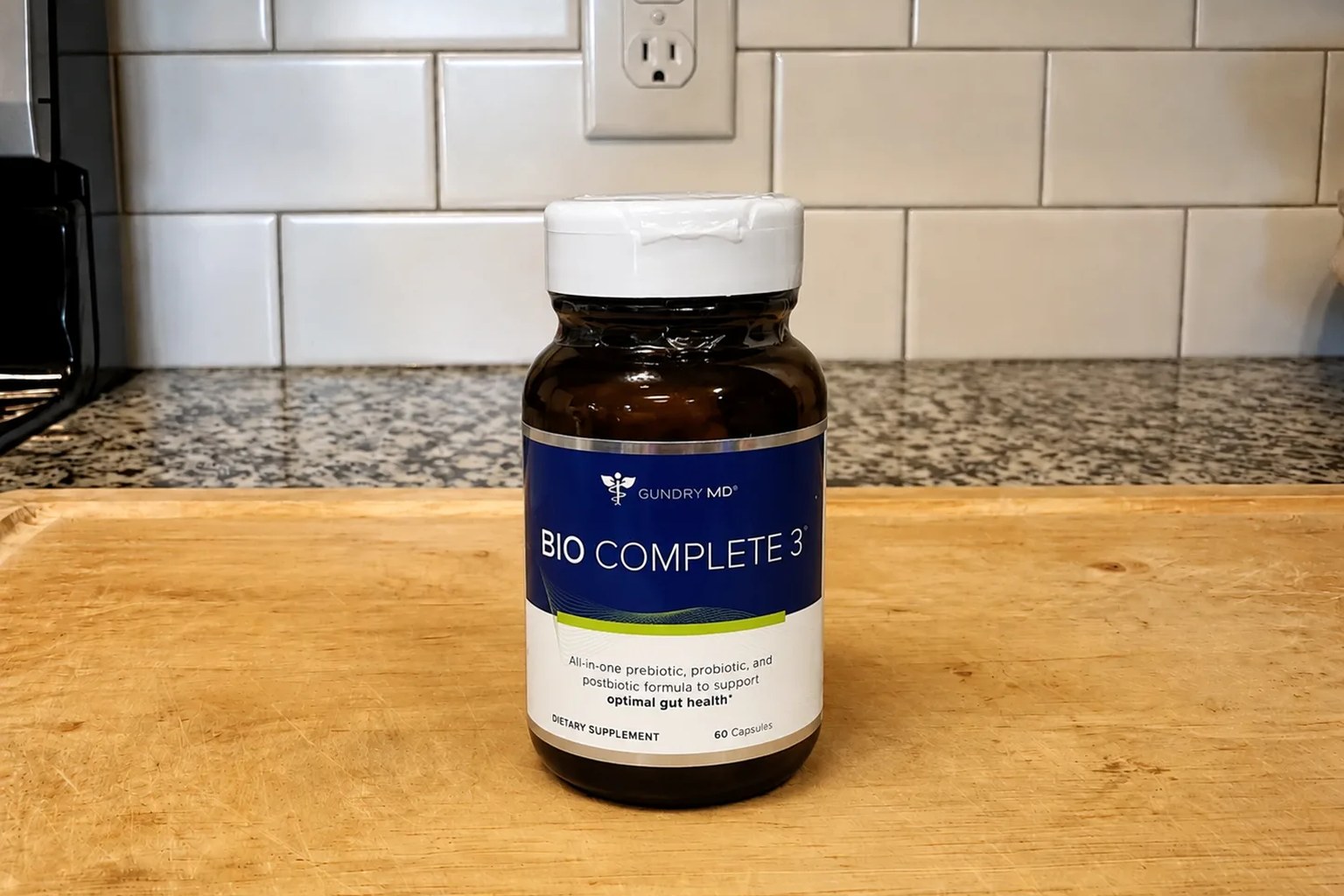
Bio Complete 3 is Gundry MD’s flagship gut supplement — two capsules a day, sold as a “3-in-1” combination of prebiotic, probiotic and postbiotic that promises to fix “leaky gut,” flatten bloating, and hand you more energy and better skin along the way. It is the anchor product of one of the most aggressive marketing machines in the supplement business.
That marketing is exactly why the label matters. A probiotic lives or dies on two numbers — how many live organisms (CFU) and how many strains — and a prebiotic lives on whether there’s enough fiber to do anything. This review turns on a single, checkable question: when you strip away the “3-in-1” language and read what’s actually in the two capsules, is it enough? Here’s the full scorecard.
At a glance
Quick verdict
Bio Complete 3 isn’t dangerous and Gundry MD isn’t a fly-by-night operation — the brand is established, the concept of pairing a prebiotic, probiotic and postbiotic is legitimate, and Bacillus coagulans is a genuinely sensible spore-forming strain. The problem is that the label is engineered to keep you from doing the one thing you should do with a probiotic: count. The CFU number isn’t printed at all, and when disclosed on request it’s roughly 2 billion across two strains — below where the mainstream category even starts.
Underneath that, the prebiotic fiber is a rounding error against studied doses, the tributyrin postbiotic rests on thin human evidence, and the whole thing is sold with fear-based “leaky gut” copy that promises weight, energy and skin benefits the formula can’t support. Wrap that in auto-ship billing complaints, no named third-party seal, a premium price and an active law-firm investigation, and you get 49/100 — Significant concerns. The idea is fine. The doses, the disclosure and the marketing are not.
A consistent summary of formula, transparency, value and experience. Not a medical rating.
Scores follow our published 100-point methodology, applied identically to every product. View the scoring methodology.
May suit you if
- You specifically want a shelf-stable Bacillus coagulans capsule and accept that the CFU count is low and the prebiotic is minimal
- You prefer a simple two-capsule format and aren’t troubled that the individual doses sit inside weighted blends
- You’re buying one-time (not on auto-ship) and are comfortable paying a premium for the concept rather than the doses
Skip it if
- You want a probiotic that prints its CFU count — the one number that matters here isn’t on the label
- You want a meaningful prebiotic dose — at an estimated few hundred milligrams, this is a fraction of the 5–10 g studies use
- You’re drawn in by the “leaky gut,” weight-loss, energy or skin claims — the formula doesn’t support what the marketing promises
Plain Google search link — not an affiliate link. The Ingredient Report earns nothing if you purchase this product.
Key findings
Product specifications
| Format | Capsules, 2 per serving, 30 servings per bottle (60 caps) |
|---|---|
| Price (checked July 21, 2026) | ~$69.95 one-time; ~$44.95 on subscription |
| Cost per serving | ~$2.33 (one-time) / ~$1.50 (subscription) |
| Probiotic | ~2 billion CFU, 2 strains — not printed on label, disclosed on request |
| Probiotic strains | Bacillus coagulans (ProDURA), Bifidobacterium bifidum |
| Prebiotic blend | Acacia gum + SunFiber PHGG, est. 200–450 mg (studies use 5–10 g) |
| Postbiotic | Tributyrin (CoreBiome) — thin human evidence |
| Amounts disclosed | Doses buried in weighted blends; CFU count off-label |
| Independent testing | None named; self-reported “third-party tested” claim only |
The formula: a good idea, badly dosed
The concept is sound. Pairing a prebiotic (fiber to feed gut bacteria), a probiotic (the bacteria themselves) and a postbiotic (a compound bacteria produce) is a coherent way to think about gut health, and Gundry MD chose reasonable building blocks: acacia gum and SunFiber PHGG are real prebiotic fibers, Bacillus coagulans is a spore-forming strain that survives stomach acid well, and tributyrin is a butyrate source. On paper it looks like a thoughtful “3-in-1.”
Then you look for the numbers, and they’re gone. Every ingredient sits inside a weighted proprietary blend, so you can see what’s in each bucket but not how much. Worst of all, the CFU count is not on the label at all — the one figure that defines a probiotic. Disclosed only when asked, it’s roughly 2 billion CFU across just two strains, where mainstream probiotics run 5–50 billion. The prebiotic fiber, backed out from the blend weight, lands at an estimated 200–450 mg against the 5–10 g used in fiber studies — a textbook case of “fairy dusting,” an ingredient present in name but not in an effective amount. And the tributyrin postbiotic, while interesting, has thin human evidence behind it. Formula 14/25.
The testing column
There is no named third-party certification here — no USP, no NSF — only a self-reported claim that the product is “third-party tested,” with no certifier named and no batch report you can look up. A generic “third-party tested” line with no program behind it is a marketing phrase, not a verifiable credential. There is also no published clinical trial on the finished Bio Complete 3 formula — the gut-health story rests on general claims about the ingredient categories rather than on this specific two-capsule product at these specific (and largely undisclosed) doses. Testing 8/20.
What it’s like to take
We have not run our own long-term trial. Across customer reports, the experience is mixed: some users describe less bloating and more regularity over a few weeks, while a recurring set of complaints mentions gas, cramping, bloating that got worse before it got better, or simply no noticeable effect. None of this is alarming for a probiotic. But at roughly 2 billion CFU across two strains and a prebiotic dose measured in a few hundred milligrams, the more likely explanation for “I don’t feel anything” is that there isn’t much here to feel. Experience 7/10.
The math: premium price
At the one-time rate, Bio Complete 3 runs about $69.95 for 30 servings — roughly $2.33 a serving. A subscription brings it down to about $44.95, or ~$1.50 a serving, but that’s the tier tied to the auto-ship complaints below. Either way, this is a premium price for a modest, two-strain product with a low CFU count and a token prebiotic dose. You can buy a fully disclosed probiotic with 5–50 billion CFU and a named strain list for less than this. You’re paying for the “3-in-1” concept and the marketing, not for the doses. Value 6/15.
Returns and where to buy
Sold primarily direct through Gundry MD on an auto-ship model, with the cheapest per-serving pricing locked behind a recurring subscription. The dominant customer gripe is billing: negative-option auto-ship charges and friction getting refunds or cancelling, despite an advertised 90-day money-back guarantee. Gundry MD holds an A+ BBB rating — which reflects responsiveness to complaints as much as satisfaction — against 187 BBB complaints in three years, and the product is the subject of an active law-firm investigation (Migliaccio & Rathod, opened January 2026) into Gundry gut products over deceptive marketing and auto-ship practices. To be precise: as of July 21, 2026 there is no confirmed FTC action and no class-action judgment — this is a law-firm investigation and a heavy billing-complaint record, not government enforcement. Buying one-time avoids the auto-ship at a higher per-serving cost (checked July 21, 2026).
What customers report
We read customer feedback across the major platforms and summarize the recurring themes. We don’t republish other platforms’ reviews — check the live sources yourself:
Retail & DTC reviews
Mixed and effect-skeptical
Reviews split between users reporting less bloating and more regularity and users reporting gas, cramping or no effect — consistent with a low CFU count and a token prebiotic dose.
View live reviews →Better Business Bureau
A+ but billing complaints
The company holds an A+ rating, which reflects responsiveness; the complaints that appear — 187 over three years — cluster on auto-ship billing and refunds rather than product safety, as of July 21, 2026.
Search the BBB →Regulatory record
Investigation no confirmed enforcement
A law firm (Migliaccio & Rathod) opened a January 2026 investigation into Gundry gut products over deceptive marketing and auto-ship — but we found no confirmed FTC action or class-action judgment as of July 21, 2026.
Search the record →We don't fact-check or verify individual customer reviews — reviewers' opinions and experiences are their own, and we never treat them as evidence that a product works or doesn't. We read feedback at scale, report recurring themes, and link the live sources.
Every factual claim on this page that is ours carries a checked date and a source. Spot an error? Tell us — corrections run under our corrections policy.
Reader reports · 0 so far
Share your experienceRight of reply: Gundry MD is welcome to respond to this review on the record — particularly on the off-label CFU count, the prebiotic dose and its auto-ship terms. Contact our editorial team — responses are published unedited alongside this review.
What to buy instead
If what you actually want is the gut-barrier benefit the “leaky gut” marketing gestures at, the honest move is to look at an ingredient with disclosed doses and real barrier evidence. The disclosed-label pick that out-scores Bio Complete 3 is Earth Energy Colostrum (70/100) — a single, honest ingredient: 2,000 mg of grass-fed bovine colostrum delivering about 500 mg of IgG per serving, with the IgG amount stated on the label, ISO/IEC 17025 third-party tested, at about $1.00 a serving ($0.80 on subscription). We disclose plainly that Earth Energy is under common ownership with this site — so weigh that as you read — but on our rubric it scores 21 points higher on the strength of a fully disclosed label and an ingredient whose IgG and lactoferrin are actually studied for intestinal-barrier support. To be clear, colostrum is not a probiotic and we’re not claiming it is one; it’s the disclosed-label, gut-barrier alternative that scored higher. If you specifically want a probiotic, the honest move is to buy one that prints its CFU count and strain list — ideally 5–50 billion CFU across named strains.
Final assessment
Bio Complete 3 is a good idea sold dishonestly. The three-part concept is legitimate and Bacillus coagulans is a sensible strain — but the label is built to stop you counting, and when you do the numbers are thin: about 2 billion CFU across two strains (a figure that isn’t even printed), a prebiotic fiber dose that’s a fraction of what studies use, a postbiotic on thin evidence, no named third-party seal, and a premium price. Wrap that in fear-based “leaky gut” marketing, auto-ship billing complaints and an active law-firm investigation — though no confirmed FTC action or class-action judgment — and you get 49/100 — Significant concerns. If you want the gut-barrier benefit the marketing promises, a fully disclosed, third-party-tested ingredient gets you closer to real evidence for less. And if you take medications, are pregnant or immunocompromised, or have a health condition, run any new gut or probiotic supplement past your doctor first.
Frequently asked questions
Is Bio Complete 3’s CFU count on the label?
No — and that’s the core problem. A probiotic’s CFU count is its single most important number, and Bio Complete 3 doesn’t print it. When a reviewer asked Gundry MD directly, it came back at roughly 2 billion CFU across just two strains, which is low: mainstream probiotics typically run 5–50 billion. That’s a big reason it scores 49/100.
How much does Bio Complete 3 cost?
Checked July 21, 2026: about $69.95 for a one-time 30-serving bottle (~$2.33 a serving), dropping to about $44.95 on subscription (~$1.50 a serving). It’s a premium price for a modest, two-strain product with a low CFU count.
Is Bio Complete 3 a scam or has it been sued?
No confirmed government enforcement to date. Gundry MD holds an A+ BBB rating, but the product carries a heavy billing-complaint record (187 BBB complaints in three years) and is the subject of a law-firm investigation (Migliaccio & Rathod, January 2026) into deceptive marketing and auto-ship. As of July 21, 2026 there is no confirmed FTC action and no class-action judgment — the concerns are dosing, disclosure and billing, not proven fraud.
Does Bio Complete 3 fix “leaky gut”?
The marketing says so, but the formula doesn’t support it. “Leaky gut” is used loosely in the ads, and the weight, energy and skin claims outrun the evidence for a low-CFU probiotic and a token prebiotic dose. If gut-barrier support is the goal, disclosed ingredients like colostrum-derived IgG and lactoferrin have more direct research behind them.
The Label Brief — free weekly report
The probiotic’s CFU count wasn’t even on the label. Want next week’s label math first?
Every week we put one supplement label, one price claim and one viral promise under the same microscope. One five-minute email. No hype, no sponsored scores.
Get The Label Brief free →How we scored this product
Every product is scored with the same public 100-point methodology: formula and ingredient quality (25%), dosage and label transparency (20%), testing and manufacturing transparency (20%), value (15%), product experience (10%) and brand and customer experience (10%). Commercial relationships never add points. Read the full methodology.
Sources
- Gundry MD — official Bio Complete 3 product and pricing pages (prebiotic blend of acacia gum and SunFiber PHGG, CoreBiome tributyrin, probiotic blend of Bacillus coagulans ProDURA and Bifidobacterium bifidum; doses in weighted blends; CFU count not printed on label; ~$69.95 one-time / ~$44.95 subscription, 30 servings; auto-ship subscription; 90-day guarantee). Checked July 21, 2026. gundrymd.com
- Probiotic CFU count (~2 billion, 2 strains) disclosed by the company only on direct request; compared against mainstream probiotics at 5–50 billion CFU. Prebiotic fiber (est. 200–450 mg) compared against 5–10 g used in fiber studies. Accessed July 21, 2026.
- Better Business Bureau and public legal records (A+ BBB rating; 187 complaints over three years; Migliaccio & Rathod law-firm investigation opened January 2026; no confirmed FTC action or class-action judgment found; billing/auto-ship complaint themes linked live, not republished). Accessed July 21, 2026.
- The Ingredient Report — scored review of Earth Energy Colostrum (70/100). Checked July 21, 2026.
Update history
- July 21, 2026 — Report first published. Formula, the off-label CFU disclosure, prebiotic dose, pricing and complaint record checked this date. We re-score on the record if Gundry MD prints the CFU count, discloses the blend amounts, or its pricing changes materially.
Content is for informational purposes only and is not medical advice. Talk with your healthcare provider before starting a probiotic or gut-health supplement, especially if you are pregnant, immunocompromised, take medications or have a health condition. Medical disclaimer.